6 min listen · Listen on Substack
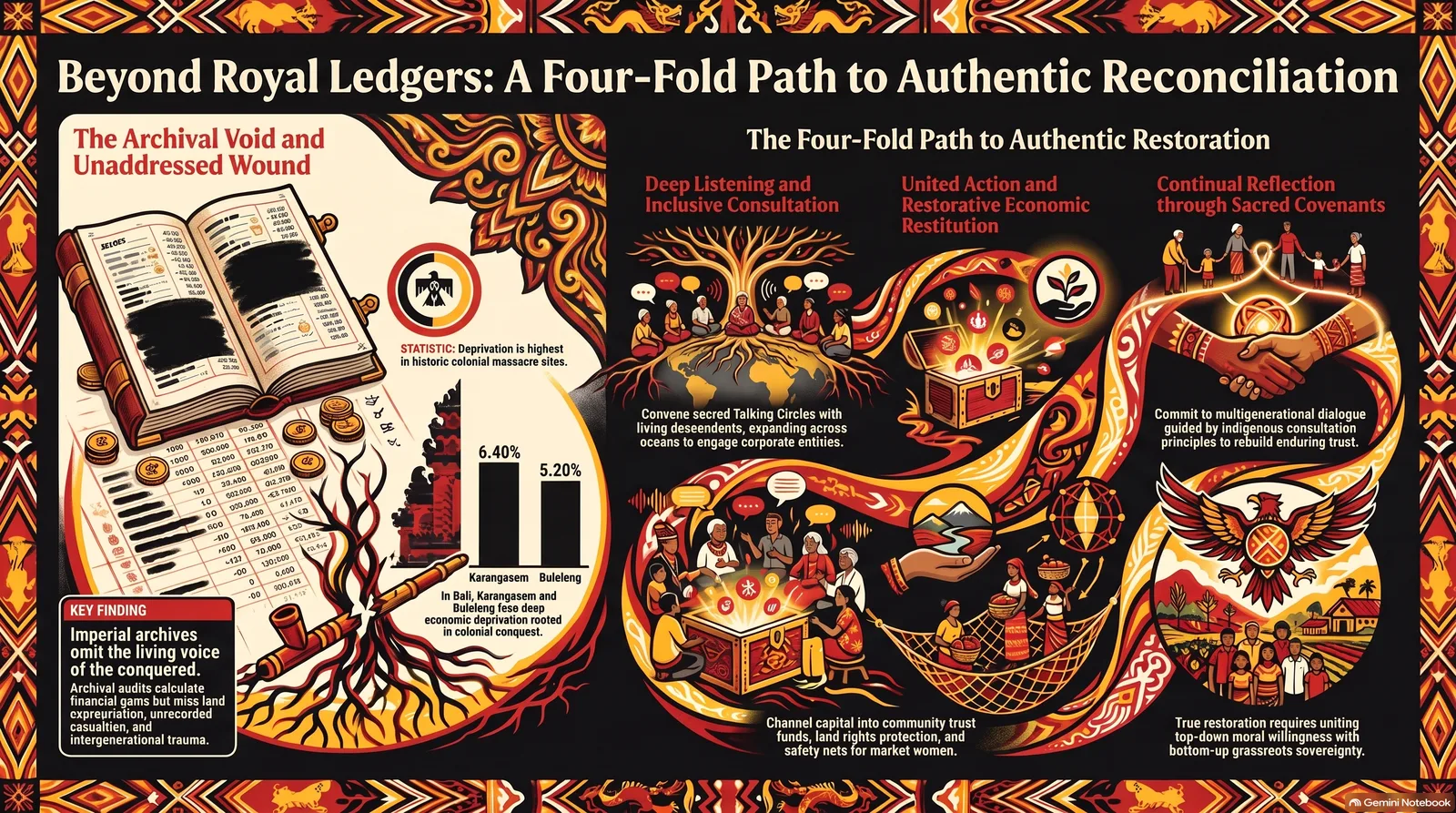
King Willem-Alexander’s historic acknowledgment of the Netherlands’ colonial past opens a door — but imperial archives and financial audits alone cannot close the wound. They ignore the living trauma carried by Indigenous peoples across generations. This piece draws on decades of kinship and ceremony in Bali, Suriname, and the Americas to argue that true healing requires bridging top-down institutional willingness with bottom-up grassroots sovereignty. It calls for expanding accountability beyond the Crown to include corporate and financial institutions that benefited from colonial extraction. Through a concrete four-part path of deep listening, inclusive consultation, united action, and continual reflection, the author provides a roadmap to transform official apologies into lasting global reconciliation.
The Common Threads of Dutch Colonial Extraction
Dutch colonial extraction across the Atlantic and Pacific operated not as a series of isolated outposts, but as a single, interconnected global apparatus. The primary threads connecting extraction across both oceans include:
A Unified Imperial Ledger and Reinvested Capital: Wealth extracted from both hemispheres flowed into the same financial ledgers, merchant banks, royal vaults, and municipal infrastructure funds in Amsterdam, Rotterdam, and The Hague. Profits generated from spice monopolies in the Moluccas were directly reinvested into the transatlantic slave trade and Caribbean plantation mortgages.
Cross-Pollination of Extractive Machinery: Administrative techniques developed to enforce forced agricultural production in the Dutch West Indies were used to design Java’s catastrophic Cultivation System, the Cultuurstelsel, introduced in 1830.
Transoceanic Labor Relocation: Following the formal abolition of chattel slavery in Suriname in 1863, the colonial apparatus solved plantation labor shortages by turning directly to its eastern empire. Between 1890 and 1939, the Dutch transported nearly 33,000 Javanese contract workers across the globe to Suriname, creating an artificially fractured, racially divided working class tied to plantation dependencies.
Dispossession of Indigenous Lands and Suppression of Customary Law: Both hemispheres saw violent territorial expropriation where colonial authorities declared communal lands as state property through the domeinverklaring, systematically overriding millennia-old customary tenure systems known as adat. In the Atlantic, Indigenous nations like the Kali’na and Lokono were dispossessed of coastal estuaries to construct plantations. In the Pacific, sovereign kingdoms across Java, Sumatra, the Moluccas, and Bali were militarily subjugated and stripped of hereditary authority.
Replacement of Native Self-Sufficiency with Extractive Monopolies: Colonial governance treated traditional customary trade and sovereign refusal as direct acts of war. Local self-sufficiency was dismantled and replaced with mandatory commodity extraction — whether through chattel plantation slavery in Suriname, total spice monopolies and depopulation campaigns in the Banda Islands, or forced cash-crop farming in Central Java.
Shared Structural Legacy and Intergenerational Trauma: Descendants on both sides of the planet carry the same unresolved inheritance of racial hierarchy, landlessness, cultural dislocation, and economic marginalization. This shared wound connects Indigenous and Maroon communities fighting for land rights in Suriname with families in Bali’s historic kingdoms — such as Karangasem, Buleleng, and Klungkung — who experience deep poverty on lands confiscated following the colonial invasions.
The 2025 Ceremonies in Bali
The January 2025 ceremonies in Bali connected Indigenous traditions by weaving spiritual practices, ceremonial fires, and ancient prophecies from the Americas with those of the Indonesian archipelago.
The Bali Four Directions Ceremony for World Peace, held January 20, 2025, at Akasha NewEarth Haven in Keliki, Ubud, was co-officiated by Dakota hereditary leader Chief Phil Lane Jr. alongside Balinese High Priest Ida Rsi Wisesanatha and High Priestess Ida Rsi Mahadevi. Together with hereditary leaders like Raja Samu Samu VI and relatives from many nations, they raised prayers calling upon Wakan Tanka, Father Sky, and Beloved Mother Earth to activate the Rainbow Prophecy.
Participants brought the ashes of the 8th Fire of World Peace — originally kindled in Hidalgo, Mexico, in October 2023 — and added them directly into the Sacred Fire of Bali. This created a direct spiritual link between Mesoamerican and Turtle Island traditions and the spiritual keepers of Indonesia.
The 8th Fire Alignment Ceremony, held January 25, 2025, saw Chief Phil Lane Jr. sit with the Balinese High Priest of Fire to form a solemn spiritual covenant. This covenant bound the global 8th Fire ashes to more than 200 Sacred Fires burning throughout the Indonesian archipelago.
The rituals formally activated the Union of the Condor, Hummingbird, Quetzal, and Eagle — traditionally uniting the Indigenous peoples of North, Central, and South America — and extended its mantle to encompass traditional Indonesian and Pacific leadership.
The rituals were intentionally designed not as isolated events, but to establish Bali as a “prepared ground.” This ceremonial alliance created a living spiritual bridge linking grassroots customary sovereignty in Bali with Indigenous and Maroon communities fighting for land rights in Suriname, West Papua, Maluku, and the Americas.
The Connection with the Netherlands
Chief Lane’s connection with the Netherlands spans more than seven decades, evolving from a childhood gesture of compassion into decades of community healing and spiritual covenants.
The relationship began in 1953 when he was an eight-year-old Dakota boy carrying White Swan and White Buffalo Dakota teachings. Following the catastrophic North Sea flood that devastated the Netherlands, his father taught him to pack his best toys and ship them across the ocean to a boy his age in Rotterdam named Hans Grootmeier. Months later, Hans’s family sent back a parcel containing wooden shoes, Dutch chocolates, tulip bulbs, and Dutch beer.
Ten years later, in 1963, Chief Phil Lane Jr. traveled to Rotterdam and shared dinner with Hans and his family high above the harbor at the Euromast, transforming a childhood connection into lifelong kinship.
In 1995, he met Dutch philanthropist Fred Matser at the State of the World Forum in San Francisco. Through major gatherings like the Encounter of Worldviews at Kasteel De Vanenburg in 2002 and the World Dialogue Foundation, he helped establish Four Worlds Europe to steward respectful dialogue and Indigenous methodology.
He brought Cree Elder-guided Talking Circle methodologies directly into Rotterdam’s most vulnerable neighborhoods, working alongside municipal leaders, police commanders, social workers, street sex workers, and individuals in recovery to dissolve mistrust and build shared solutions. He also lived for a week at Nora’s Nest, a refuge for individuals recovering from heroin dependency.
Through annual professional workshops, over 500 Dutch civil servants, officers, and administrators across Rotterdam, The Hague, and Amsterdam were trained in consultation principles. Well over one hundred Dutch leaders undertook the Dakota Staking Ceremony, receiving a Sacred Stake to bind themselves unconditionally to peace, truth, and community service.
The Dakota Staking Ceremony
The Staking Ceremony carries forward a profound, ancient Dakota warrior tradition. Historically, in times of battle, a warrior would ride into the conflict, dismount, drive a wooden stake into Mother Earth, and bind himself directly to it—relinquishing any possibility of retreat or escape and offering his life so the fighting would end and future generations might live.
In contemporary practice, this ceremony carries forward that same selfless commitment as a solemn, unconditional spiritual covenant. Rather than physical combat, it represents an unyielding vow to stand unconditionally for truth, justice, peace, community service, and the protection of all life.
During the Encounter of Worldviews gathering at Kasteel De Vanenburg in November 2002, facilitators received a Four Worlds Sacred Talking Stick through a Staking Ceremony. The ceremony was later passed to Dutch stewards Brother Bernhard Holtrop and Sister Karin Lindeman-Boere to steward across Europe.
By receiving a Sacred Stake, well over one hundred Dutch leaders — including police commanders, municipal officials, civil servants, and social workers in cities like Rotterdam, The Hague, and Amsterdam — bound themselves to act as Talking Circle facilitators, dissolving mistrust between authorities and marginalized neighborhoods.
The Role of Traditional Banjar Village Councils in Modern Bali
In modern Bali, traditional banjar village councils serve as the bedrock of bottom-up grassroots sovereignty and local customary governance.
Banjar councils represent the lived, daily reality of local communities on the land. Working alongside traditional subak water keepers, elders, market women, and youth, they maintain customary laws, cultural continuity, and local decision-making.
In the proposed four-fold restorative process, banjar village councils are central to the Deep Listening phase. They sit in sacred Talking Circles alongside descendants of Bali’s historic royal houses — such as Badung, Pemecutan, and Klungkung — to articulate ancestral memories, identify intergenerational wounds, and define self-determined visions for spiritual, educational, and environmental renewal.
Banjar councils ensure that community development and healing originate from within the community rather than being handed down as administrative decrees. Grounding decisions in banjar leadership ensures that external initiatives respect local sovereignty and uphold the principle of Free, Prior, and Informed Consent.
The Four-Part Path
The 2025 ceremonial alignments in Bali serve as the spiritual engine and structural template for the practical Four-Part Path. Rather than treating reconciliation as an administrative or academic exercise, the ceremonies established a “prepared ground” that bridges top-down institutional willingness — such as royal apologies and open archives — with bottom-up grassroots sovereignty.
Deep Listening (Centering the Descendants)
Grounded in the sacred protocol of the Talking Circle — where the talking piece passes with patience and status is set aside so an imperial monarch and a village elder hold equal sacred dignity — this step creates unhurried ceremonial space. It centers the living descendants of Bali’s royal houses, traditional banjar village councils, and subak water keepers to articulate ancestral memories, identify intergenerational wounds, and define their own self-determined restoration.
Inclusive Consultation (Expanding the Circle Across Oceans)
Informed by the multi-hemispheric Union of the Condor, Hummingbird, Quetzal, and Eagle activated during the 8th Fire alignment, the circle expands across the oceans to encompass the entire interconnected colonial apparatus. It brings in diaspora communities in the Netherlands — Indonesian, Moluccan, Surinamese — historians, and the private banking and commercial conglomerates whose modern assets were built on forced labor and colonial extraction.
United Action and Restorative Economic Restitution
The ceremonies established that spiritual covenants must yield tangible, practical repair governed by Free, Prior, and Informed Consent. Action translates ceremonial commitments into the repatriation of sacred heirlooms and krises, legal protection for customary lands, direct community-governed trust funds for high-poverty districts — Karangasem, Buleleng, Klungkung — and relief for Balinese women who carry uncompensated ceremonial and economic burdens. This establishes a living model in Bali that can immediately extend to Suriname and the Americas.
Continual Reflection (The Sacred Covenant)
Embodying the spirit of the Dakota Staking Ceremony — an unconditional spiritual vow to stand for truth, peace, and service without retreat — continual reflection ensures that healing is not treated as a single financial transaction or one-time event. The partners commit to an ongoing, multi-generational circle to review progress, acknowledge mistakes with humility, and maintain commitments to natural laws of balance and harmony.
The Path Forward
The four-part restorative framework proposes engaging private Dutch commercial banks and corporate successors alongside the Crown. The wealth extracted from both hemispheres did not remain in royal vaults alone — it flowed into merchant banks, insurance companies, shipping conglomerates, and municipal infrastructure funds that still shape Dutch prosperity today. Any genuine reckoning must therefore include these institutions, not as an afterthought, but as central participants in the restorative process.
The ceremonies in Bali, the decades of kinship with the Netherlands, the Dakota Staking Ceremony, and the banjar councils of Bali all point toward the same truth: healing cannot be decreed from above, nor can it be achieved through financial transactions alone. It requires the patient, unhurried work of listening, consulting, acting, and reflecting — across oceans, across generations, and across the full spectrum of those who were harmed and those who benefited.
The door King Willem-Alexander opened is real. But a door is only the beginning. What lies beyond it is the harder, more beautiful work of genuine reconciliation — and that work belongs to all of us.